
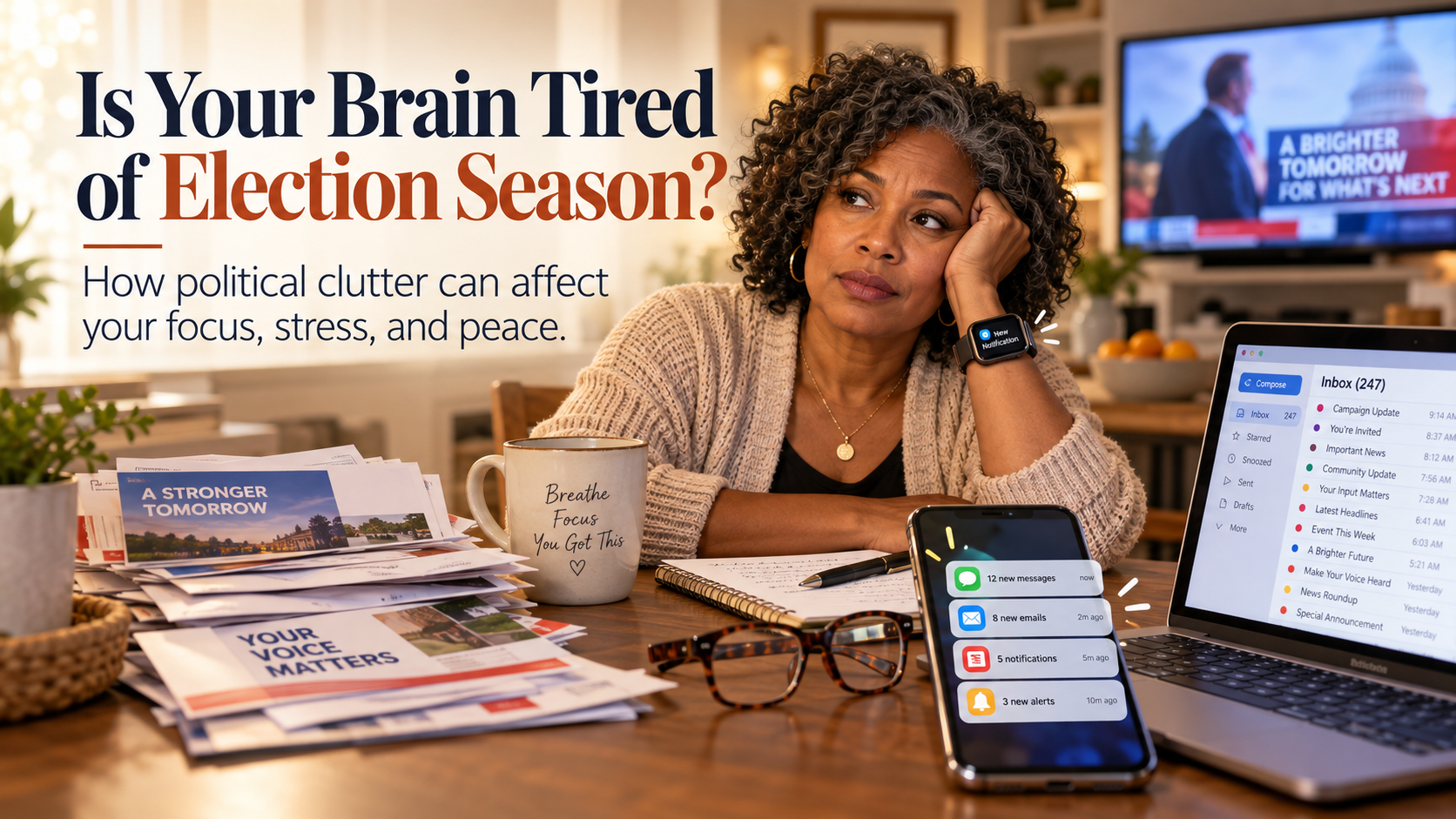
I don’t know about you, but lately it feels like everybody wants my attention. My mailbox wants it. My inbox wants it. My phone wants it. Television wants it. The radio wants it. And social media definitely wants it.
Election season has a way of showing up everywhere. Emails,
text messages, commercials, postcards, videos, news alerts and social media
posts. Then there are the deadlines, opinions, arguments, predictions, and
information about how much money is being spent this election.
And even if you have already voted, the clutter does not necessarily stop. The emails and texts keep coming. The commercials are getting more frequent and your mailbox is still piling up. Social media keeps serving up one more opinion, one more reaction, one more reason somebody thinks you should be paying attention. So even though your ballot may already be cast, your brain may still be dealing with the noise of election season.
This means one thing for the brain: Clutter.
All of this is not just political advertising or information, it’s clutter! And clutter has a way of making the brain work harder than we realize.
Clutter Is More Than a Messy Room
Maybe It Is Time for an Election-Season Brain Declutter
You do not have to delete every app, clean your entire house, or go off the grid. In fact, trying to overhaul everything at once can create more overwhelm. Sometimes one small change is enough to create some relief. That was another key point from my bootcamp clutter lesson: one cleared surface, one quieter corner, or one simplified digital habit can reduce the amount of information your brain has to manage. Here are a few places to start.
· Unsubscribe without guilt. If you are getting multiple emails saying essentially the same thing, you do not need all of them.
· Silence some notifications. You can decide when you want to check your messages instead of allowing every ping to decide for you.
· Deal with the mail. Read what you need. Keep what is important. Throw the rest away.
· Choose when you consume news. You can stay informed without having commentary running in the background all day.
· Clear the mental leftovers. Write it down or pray about it. Talk it through. Take a walk or step away from the screen. And then give yourself permission to release it.
Sometimes I have to remind myself: There are things I need to know. There are things I need to pray about. There are things I need to act on. And there are things I simply need to let go.
Your Brain Needs Somewhere Quiet to Land
One of my favorite scriptures says: “For God is not a God of disorder but of peace.” — 1 Corinthians 14:33. I like that word peace. Because peace does not require us to be uninformed nor does it require everyone around us to agree. And it certainly does not require us to ignore what is happening in the world. But peace may require boundaries. Sometimes peace looks like turning off the television. Sometimes it looks like muting the group chat. Sometimes it looks like deleting the email without reading every word. And sometimes it looks like saying, “I have already made my decision. I do not need to keep carrying this.”

Election season will eventually end but information overload will not. So maybe this is a good time to practice deciding what deserves access to your attention. Every notification does not require a response. Every opinion does not require your emotional energy. Every piece of information does not deserve space in your head.
And remember: Every message does not deserve access to your brain just because somebody figured out how to get access to your phone.
Protect your peace, and your focus and give your brain some room to breathe.
Less clutter around you can create more clarity within you.
Blessings,
Dr. Janice R. Love
In Her Right Mind