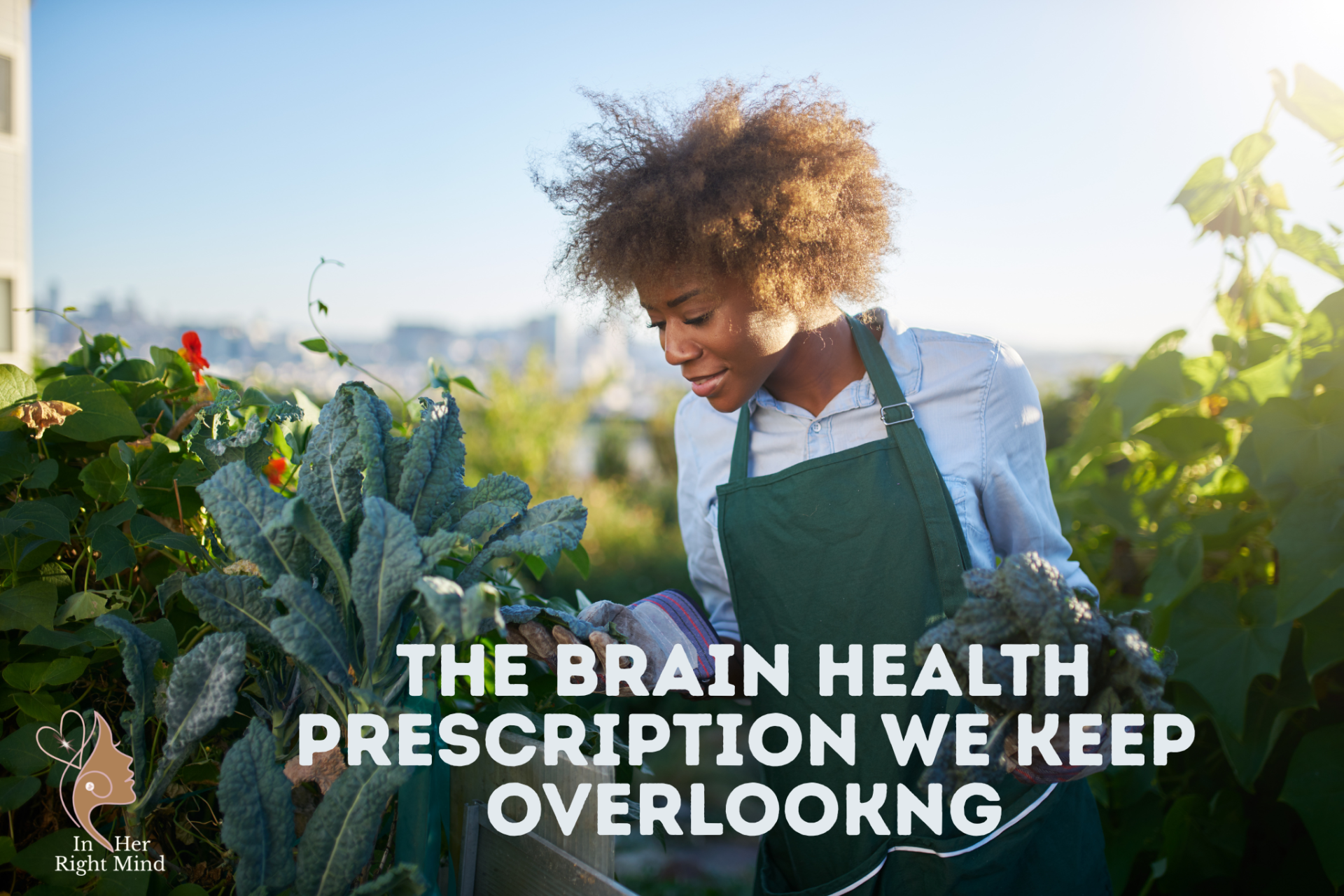
Sis, when we talk about protecting our brain health, we
usually go straight to the things we put into our bodies. What are we
eating? Are we drinking enough water? Are we getting enough sleep? Are we
moving? What about our hormones, blood pressure, stress levels, or medications?
Those are all important questions. And lately, another
question has been sitting with me:
What are we putting our brains into?
In other words, what kind of environment are we spending most
of our time in? I have been reading Nature and the Mind: The Science of How
Nature Improves Cognitive, Physical, and Social Well-Being by Marc G.
Berman, PhD, a psychologist and researcher at the University of Chicago whose
work examines how our physical environments shape our brains and behavior. One
idea that stopped me in my tracks was something he calls a nature
prescription.
The more I read, the more I kept thinking - I already knew
this. I just didn't have a name for it.
I Didn't Know I Was Giving Myself a Nature Prescription
During the pandemic, when we were sheltering in place and the
world felt like it was closing in, I discovered something that surprised me:
being at home did not have to mean staying inside.
Hubby and I started spending so much more time outdoors. I
took Zoom calls from the deck. I started taking daily walks - sometimes two or
three times a day. I paid more attention to my flower beds and our garden. I
watched the trees bud in the spring and the leaves fall when the seasons
changed. When it snowed, I grabbed my coat, took pictures, and helped shovel
the driveway.
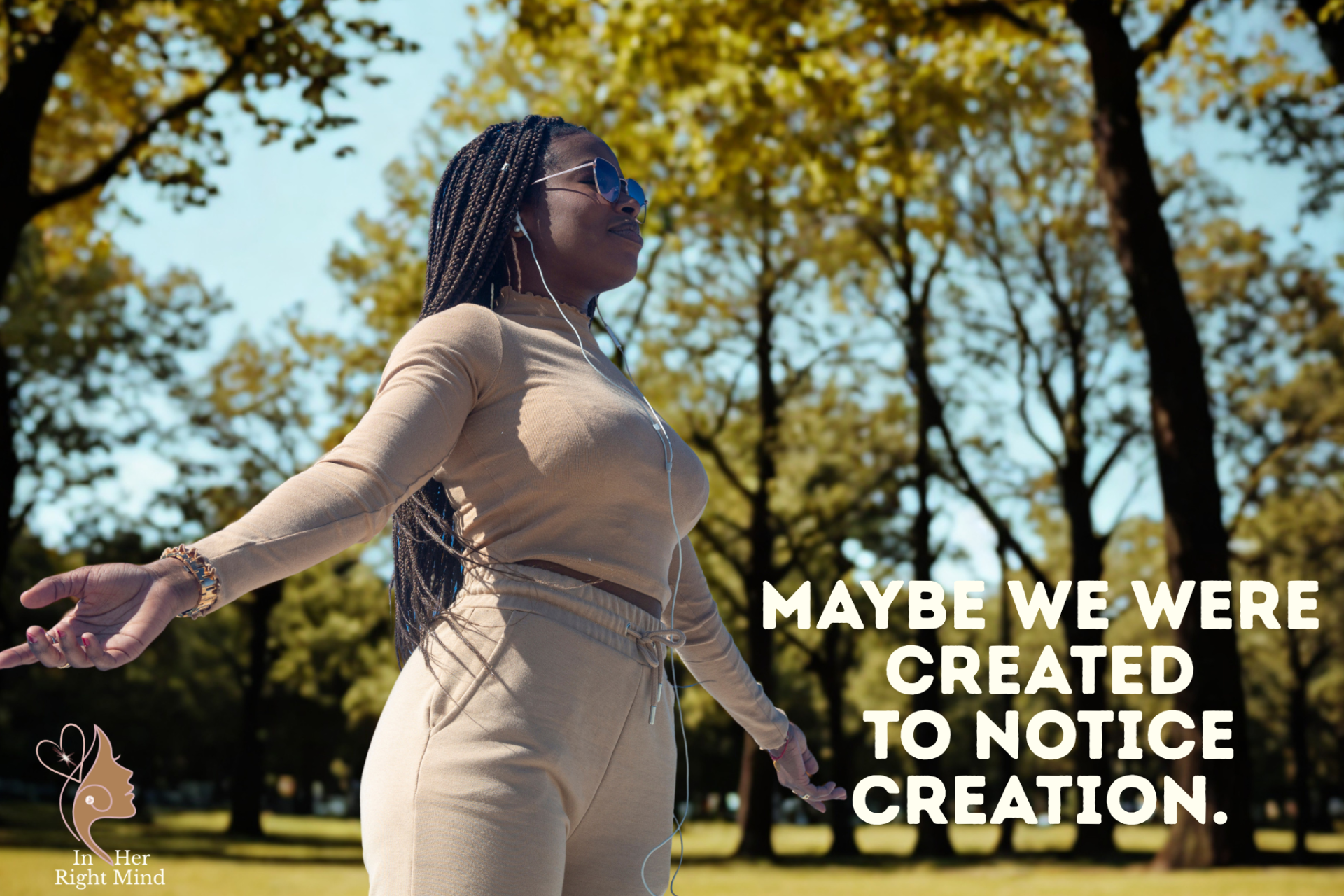
Sometimes I simply went outside barefoot - feet on the
ground, face to the sky.
I waved at neighbors passing by on the walking trail. Small
things, honey. But somehow those small things made life feel better. The days
felt less heavy, and I didn't feel quite so crushed by everything happening
around us.
What started as something we did just to cope became
something we continued because it genuinely made us feel good. We still take
our morning walks today.
Looking back, I realize I was doing more than just getting
out of the house. I was giving my mind a change of scenery, my body a reason to
move, and myself a chance to reconnect with the world around me. I didn't call
it a nature prescription then. I just knew I felt better when I got outside.
Now I'm learning that far more was happening in my brain during those walks
than I ever realized.
Nature Can Give an Overworked Brain a Break
Let's talk about attention for a moment - because this part
really spoke to me.
Think about how much we ask of our attention every single
day. Phones ringing. Notifications popping. Televisions playing in the
background. Emails to answer, social media to scroll, conversations to follow,
appointments to remember, and dinner to figure out - all at the same time. Our
brains are constantly making decisions:
Pay attention to this. Ignore that.
Remember this. Stay focused.
All of that takes real mental energy. Research led by Berman
has found that spending time in natural environments helps restore our ability
to focus and direct our attention. Nature captures our attention more gently
than busy urban environments, giving the parts of our brain responsible for
focused attention a chance to actually rest and recover.
That landed for me. Because when women come to me saying they
are struggling with concentration, mental fatigue, or brain fog, our first
thought is often: Something must be wrong with my memory. And maybe
something is worth checking out. And sometimes? The brain may simply be
overloaded. Worn out. Running on empty.
And one of the most accessible things we can do for an
overloaded brain is change its environment.
Green May Be Good for the Brain
Trees. Gardens. Parks. Grass. Flowers. Walking trails.
These are not just pretty things to look at, beloved. A
growing body of research has found connections between exposure to green space
and several aspects of health - including mental well-being, physical activity,
and cognitive functioning.
Research involving middle-aged women specifically found that
living around more green space was associated with better processing speed,
better attention, and stronger overall cognitive function. That is worth
sitting with for a moment.
Researchers are still studying exactly how strong these
connections are and what drives them. What we do know is that our surroundings
appear to be one more meaningful piece of the brain-health puzzle. And as we
move through our 50s, 60s, and beyond, that matters.
And Then There Are the Blue Spaces
Berman also writes about blue spaces - environments where
water is part of the picture. Lakes, rivers, streams, the ocean. Even simply
sitting somewhere with a view of water.
A growing body of research connects exposure to blue spaces
with positive mental health and well-being. Researchers are still working to
understand exactly why, but physical activity, stress reduction, and the
restorative qualities of water environments all appear to play a role.
And I don't know about you - but being near water is my happy
place.
There is something about looking at water that just feels
different. My shoulders drop. My thoughts slow down. My creative juices start
flowing again. I breathe differently. Deeper. Slower. More like myself.
Sometimes I don't need a study to tell me why. I just know.
Nature Also Gets Us Moving and Connecting
Here is another reason I love the idea of a nature
prescription - it touches more than just the mind.
Getting outside naturally encourages us to do other things
that support healthy aging. We move. A walk around the block is still a walk.
Tending a flower bed still counts as movement. Strolling through a park gets us
off the couch and into life.
We also connect. Remember those neighbors I waved to during
the pandemic? We weren't having long conversations. Sometimes it was nothing
more than a smile and a nod. But it was connection. And connection matters more
than we often give it credit for.
Parks, walking trails, community gardens, front porches, and
outdoor spaces all create natural opportunities to see and interact with other
people. Research on nature exposure increasingly points to physical, mental,
and social benefits working together - not separately.
What Scripture Already Knew
As a woman of faith, I cannot read about the effects of
nature on the brain without thinking about how often God takes us outside in
His Word.
Gardens. Mountains. Rivers. Trees. Fields. Still waters. The
wilderness.
God certainly meets people anywhere He chooses. And yet so
many of the most profound biblical encounters happened in natural places. The
burning bush. The Garden of Gethsemane. The shores of Galilee. The Jordan
River.
Psalm 23 doesn't say, He makes me lie down beside my
laptop.
It says:
"He makes me lie down in green pastures. He leads me
beside the still waters. He restores my soul."
Green pastures. Still waters. Restoration.
I have memorized that scripture and spoken it out loud more
times than I can count. Read those words again and sit with them a little
differently today. Maybe creation was never meant to be something we only
admired through a window. Maybe spending time in it is one of the simple,
Spirit-led ways we care for the minds and bodies God entrusted to us.
So Here Is Your Nature Prescription
I am not asking you to buy hiking boots or plan a trip to a
national park. Start right where you are.
For the next seven days, spend 20 minutes outside on purpose.
Take your morning coffee to the porch. Walk around the block.
Sit under a shade tree. Work in your flower bed. Visit a nearby park. Walk
along a lake if one is close to you. Look up at the clouds. Listen to the
birds. And for at least part of that time, put the phone in your pocket.
Then pay attention to something we rarely slow down enough to
notice:
How does your mind feel afterward? Do you feel calmer?
Clearer? Less rushed? More like yourself?
You do not have to wait until something feels wrong with your
memory before you start creating an environment that supports your brain
health. Sometimes caring for your brain looks like stepping outside, breathing
fresh air, and letting God's creation do what it was always meant to do.
The prescription we have been overlooking may have been right
outside our door all along.
Blessings,
Dr. Janice R. Love