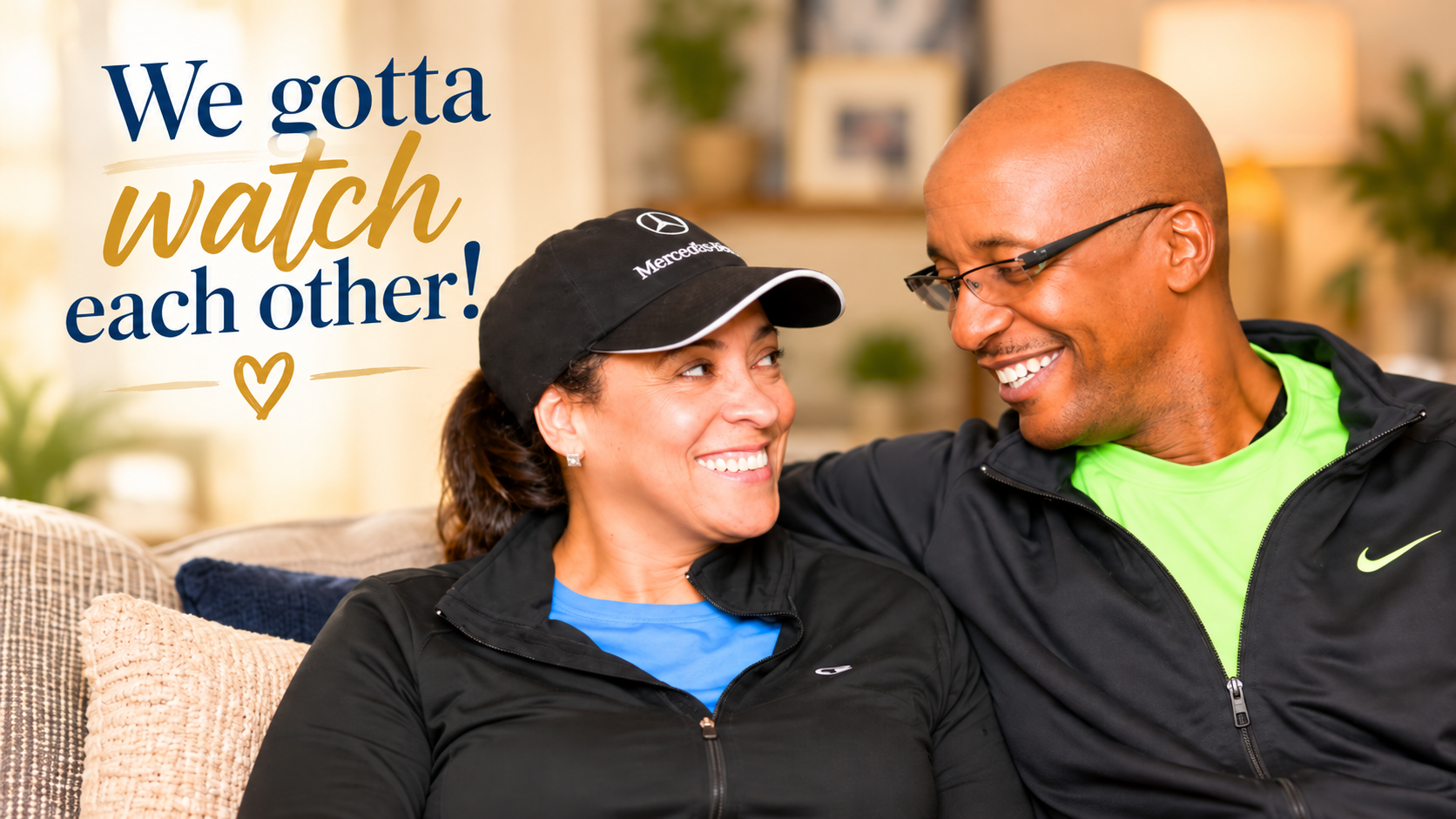
“Babe, why is the honey in the refrigerator?” “You can’t find your phone again?” “What did you do with that birthday invitation?” “Wait…you threw away a check?” “Why didn’t you start the dryer?” “Do you remember that lady’s name?”
Around our house, these little moments have become part comedy routine, part accountability system. And trust me, my husband has a list for me too. 😊 Most of the time, we laugh and tease each other. We remind each other where something belongs. But underneath all of that joking, there’s something we say to one another frequently: “I gotta watch you” or We gotta watch each other.
My husband recently turned 68, and I want his brain to stay sharp too. That desire has become even more important to me after watching him go through five weeks of radiation for prostate cancer and hormone treatment. Over the past several months, I have found myself paying closer attention to the things that affect his energy, focus, routines, sleep, and overall well-being.
Not from a place of fear, but from a place of love. Afterall, sometimes the people closest to us notice little changes before we notice them ourselves. Maybe your spouse says, “You’ve asked me that twice already.” Maybe your sister notices that you are unusually distracted. Maybe your friend asks, “Are you getting enough sleep? You just don’t seem like yourself lately.” Or maybe you are the one noticing something in somebody you love. We need each other for that.
Watching Is Not the Same as Worrying
When I say, “We gotta watch each other,” I do not mean we should monitor every forgotten word or misplaced set of keys like something terrible is about to happen. We would drive each other up the walls and make us nervous. Instead I mean pay attention. Is this an occasional moment or are we beginning to notice a pattern? Has something changed? Is stress higher than usual? Has sleep been poor? Is the person eating well and staying hydrated? Could medication, illness, or another health issue be contributing?
There is a big difference between loving observation and living in fear. One says, “I am watching for something to go wrong.” The other says, “I care about you enough to notice how you are doing.” That is the kind of watching I am talking about.
One of the things I have learned is that every memory slip
does not require panic. Sometimes it requires a hook by the door. A calendar or
a reminder on the phone. A designated place for the keys. A bottle of water or
a better night’s sleep. Sometimes, it’s turning off the television or putting
down your phone when somebody is giving you important information. Or actually
starting the dryer after you put the clothes in it. 😊
We have been putting more of those kinds of systems into
place in our own home.
Why? Because I do not believe we should expect our brains to
carry every detail of our lives without support. The more we can reduce
unnecessary mental load, the more energy the brain has for the things that
really matter.
What I Have Been Practicing at Home
Something else occurred to me recently. Many of the things I
am teaching in In Her Right Mind: Midlife Memory and Focus Renewal are
the same things I have been putting into practice with my husband over the past
six months. Paying attention to sleep, managing stress, staying and moving our
bodies. Creating routines and reducing distractions. Putting important dates on
the kitchen calendar and cross checking our electronic calendars. Talking
openly when one of us notices something. And being willing to laugh when the
honey somehow ends up in the refrigerator.
These are not complicated things, but simple does not mean
insignificant. Small habits repeated consistently can make everyday life easier
and help us become more intentional about how we support our minds.
Here is the question I want you to think about this week: Who
is paying attention to you?
And who are you paying attention to? Maybe it is your
husband, your sister, your best friend or your adult child. Your coworker or a
fellow church member. There is something powerful about having somebody who
knows you well enough to notice when something feels different.
Someone who can say, “That does not seem like you.” And
someone who can also say, “Girl, you are exhausted. Go to bed.” We need both. Brain
health does not have to be a lonely journey.
In fact, I am beginning to think we may do better when we
stop treating it like one.
So I’m Trying Something New
As I have been preparing for the upcoming bootcamp, I kept
thinking about this idea: If we gotta watch each other, why not learn
together too? So I am introducing a special We Gotta Watch Each Other
Buddy Offer. When you enroll in In Her Right Mind: Midlife Memory and
Focus Renewal for $65, you can bring one person with you at no
additional cost.
Your sister, your best friend, your spouse or your coworker.
Maybe your favorite cousin or that person you are always saying, “We need to do
better about taking care of ourselves.” Come together.
For 14 days, you will each receive a short daily video and a
simple worksheet designed to help you better understand and support memory,
focus, and mental clarity. It will only take about 10–15 minutes a day. And
on Days 7 and 14, we will have optional Zoom gatherings where you can ask
questions, connect with others, and talk about what you are learning.
We begin Sunday October 4.

Who Would You Bring?
I want you to actually think of a name. Who is the person
you would call and say:
“Come do this with me.” Because sometimes knowing
better is easier when we are learning together. And sometimes doing better is
easier when somebody else is asking: “Did you drink your water today?” “Did you
get some sleep?” “Did you take that walk?” That is community and
accountability. And sometimes, that is love.
Join In Her Right Mind: Midlife Memory and Focus Renewal
Begins October 4
Enrollment: $65
Bring one person with you FREE
Enroll Here @ https://inherrightmind.com
Let’s stop waiting until something goes wrong before we
start paying attention to our brains.
And while we are at it...
We gotta watch each other.
Blessings,
Dr. Janice R. Love